What Defines French Country Style
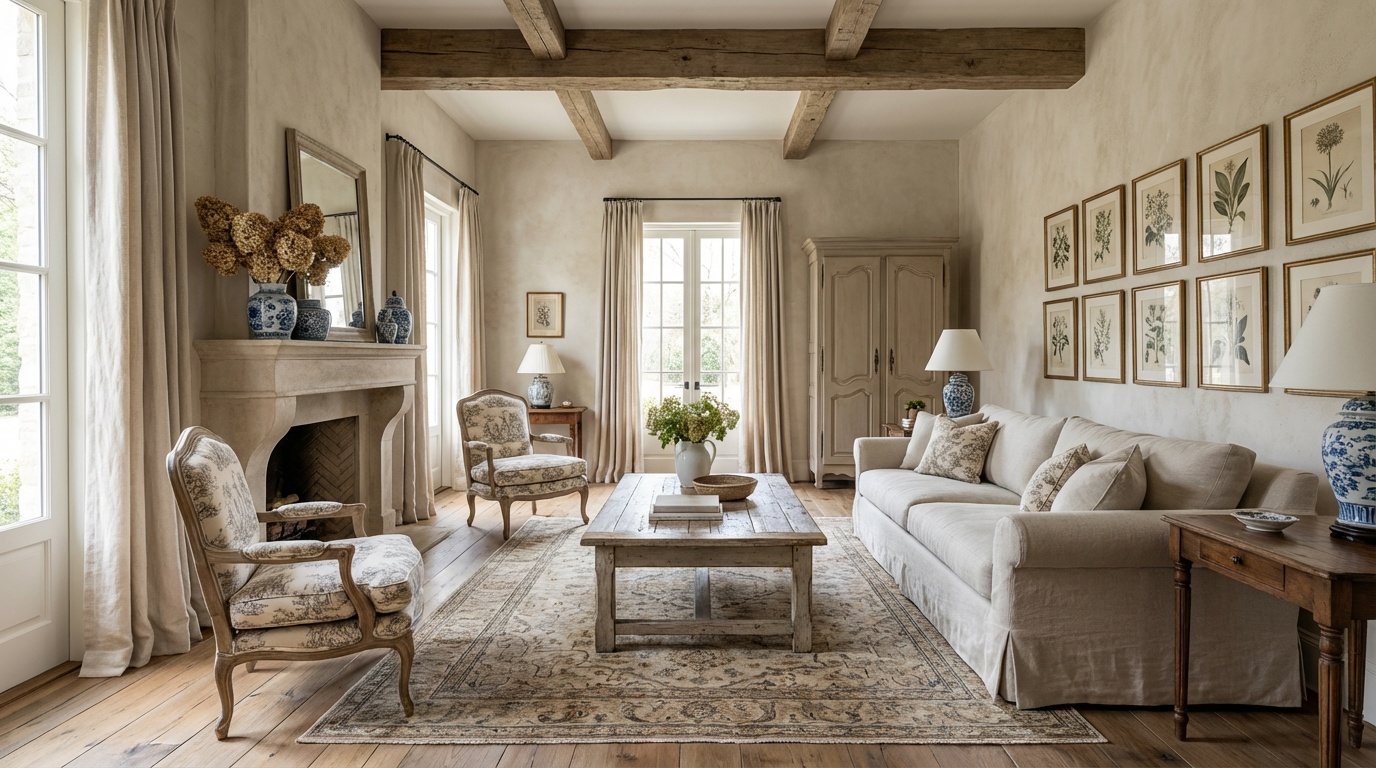
French country style is more than just a decorating trend—it's a design philosophy rooted in centuries of French provincial living. This aesthetic emerged from the rural regions of France, particularly Provence, Normandy, and the Loire Valley, where families created homes that balanced practical functionality with understated beauty. Unlike the formal grandeur of Parisian interiors, French country style celebrates the imperfect, the weathered, and the authentically lived-in.
The core principles of French country design revolve around natural materials, soft color palettes, and a harmonious blend of rustic and refined elements. This style embraces the patina of age—think distressed wood beams, worn limestone floors, and vintage textiles that tell a story. It's about creating spaces that feel collected over time rather than decorated all at once, where heirloom pieces coexist beautifully with flea market finds.
Historically, French country homes were built from locally sourced materials and decorated with what was available in the surrounding countryside. Stone walls, exposed wooden beams, terracotta tiles, and wrought iron fixtures were practical choices that have become defining characteristics of the style. The color palette was inspired by the natural landscape—lavender fields, sunflower-filled meadows, weathered stone buildings, and the soft blue skies of southern France.
What makes French country style so appealing to modern homeowners is its remarkable versatility and warmth. In an era of minimalist white boxes and industrial lofts, French country offers a refreshing alternative that prioritizes comfort without sacrificing sophistication. It's a style that encourages you to slow down, entertain graciously, and create a home that nurtures both family and guests. The living room, as the heart of the home, becomes a gathering place that feels welcoming yet elegant, casual yet curated.
French country distinguishes itself from similar farmhouse styles through its refined European sensibility. While American farmhouse leans heavily rustic and Scandinavian design favors stark minimalism, French country strikes a perfect balance—it's rustic but never rough, simple but never stark, elegant but never stuffy. The French have mastered the art of effortless elegance, and this philosophy permeates every aspect of the style.
What Defines French Country Style
Essential Elements for Your French Country Living Room
Creating an authentic French country living room begins with selecting the right foundational pieces. The furniture in a French country space should feel substantial yet graceful, with curves and ornamental details that soften the overall look.
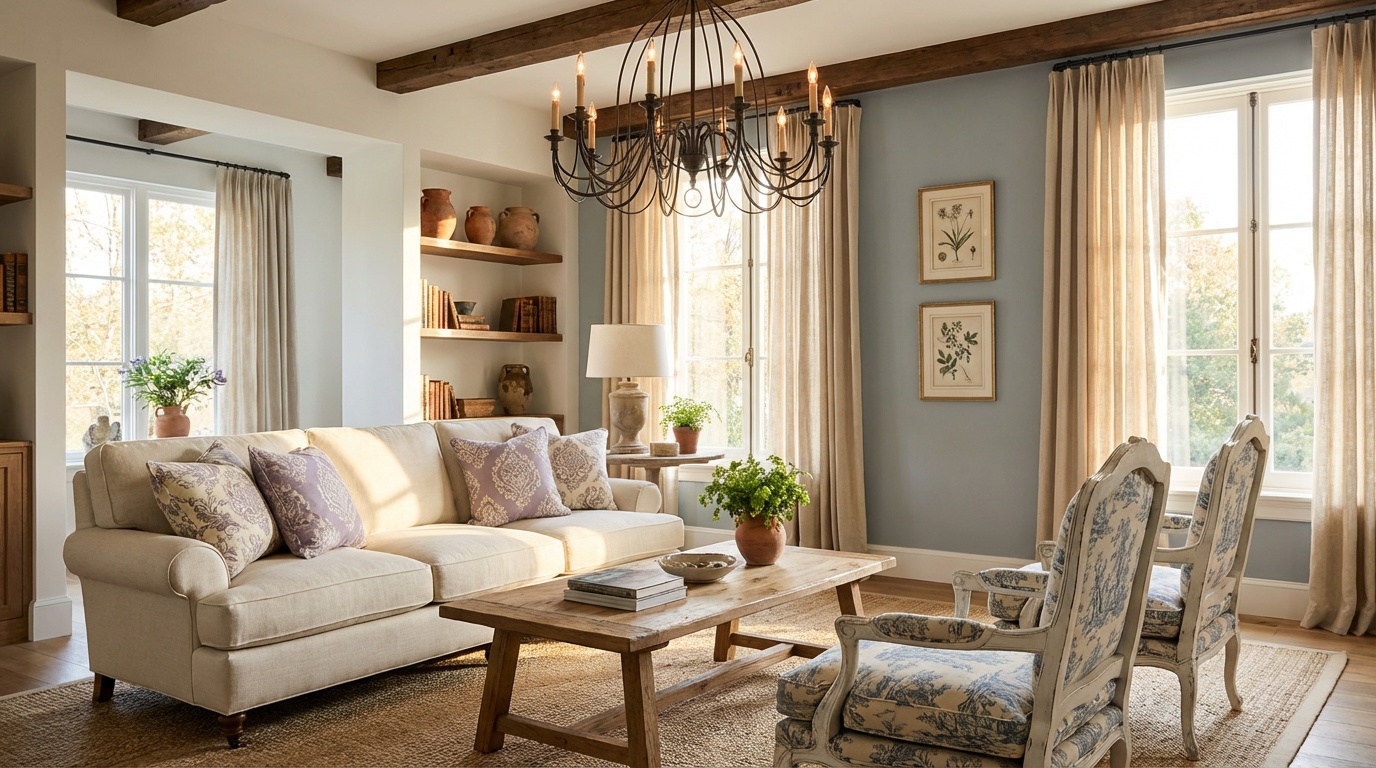
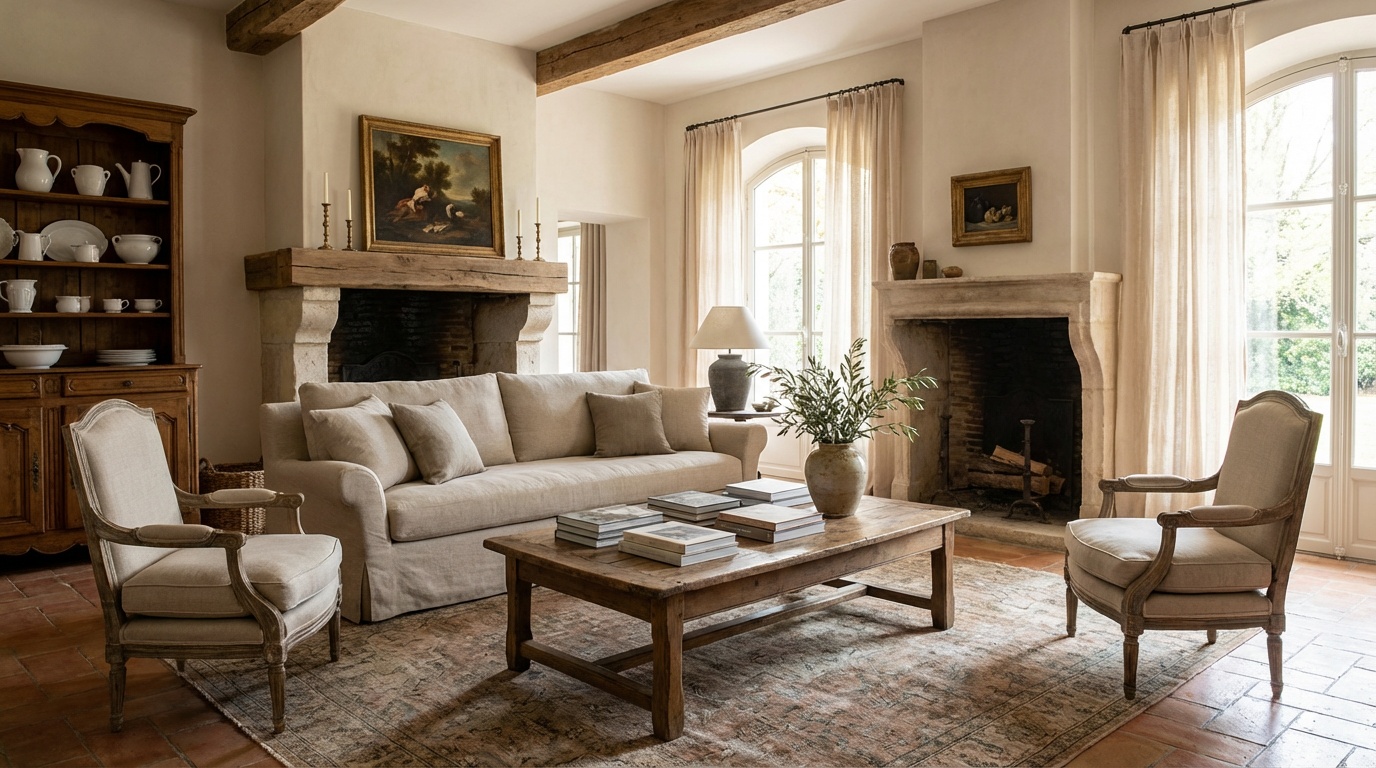
Seating is paramount in a French country living room. Look for a linen-upholstered sofa with a slightly worn appearance—think loose-fitting slipcovers in natural oatmeal, warm cream, or soft gray tones. The silhouette should be generous and inviting, with rolled arms and a slightly slouched posture that invites you to sink in. Pair this with bergère chairs (those classic French armchairs with exposed wood frames and upholstered seats and backs) or Louis XV-style fauteuils with curved legs and carved details. These accent chairs add authentic French character while providing additional seating.
A substantial coffee table serves as the room's anchor. Opt for reclaimed wood with visible grain and natural imperfections, or a painted piece in a soft, aged finish. The best French country coffee tables have a story—whether it's a repurposed farm table, an antique trunk, or a custom piece made from salvaged doors. Avoid anything too sleek or modern; the table should feel like it's been part of the room for generations.
Wood species matter in French country design. Look for oak, walnut, cherry, and fruitwoods like apple or pear, which were traditionally used in French provincial furniture. These woods should have a natural, matte finish rather than high-gloss lacquer. Painted furniture works beautifully too, particularly in chalky whites, soft grays, or muted blues that show gentle distressing at the edges and corners.
For metals, wrought iron is quintessentially French country. Incorporate it through curtain rods, fireplace screens, candle holders, or decorative wall grilles. Aged brass and bronze also work well for lighting fixtures and hardware. Avoid shiny chrome or stainless steel, which feel too contemporary for this style.
Fabrics are where French country truly shines. Linen is the undisputed king—use it for upholstery, curtains, and throw pillows. Its natural texture and tendency to wrinkle beautifully embodies the relaxed elegance of the style. Toile de Jouy, that classic French fabric featuring pastoral scenes printed in a single color on white or cream backgrounds, adds instant authenticity. Ticking stripes in navy, red, or black on cream backgrounds bring a casual, farmhouse element. Provençal prints featuring small florals, paisleys, or geometric patterns in warm yellows, reds, and blues add cheerful color.
The living room benefits particularly from French country style because it transforms what could be a formal, intimidating space into an inviting retreat. Unlike modern living room ideas that can sometimes feel cold or austere, French country creates warmth and encourages lingering conversations, leisurely reading, and comfortable entertaining.
Essential Elements for Your French Country Living Room
Color Palettes & Combinations
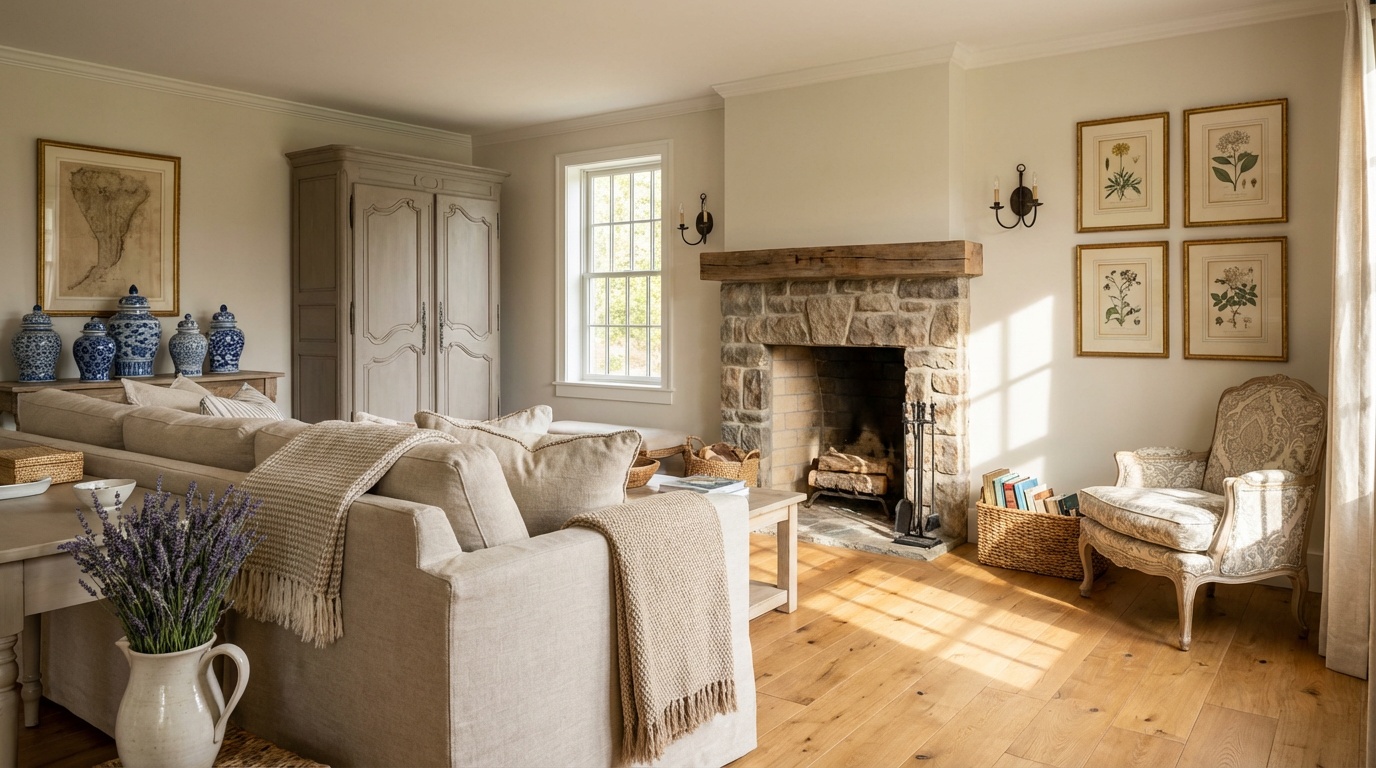
The French country color palette is directly inspired by the Provence countryside, creating a naturally harmonious scheme that feels both soothing and sophisticated.
Primary colors form the foundation of your French country living room:
- Warm Cream and Ivory: Think the color of fresh butter, aged linen, or antique lace. These soft neutrals should have warm undertones rather than stark white.
- Soft Gray-Blue: The color of weathered shutters, morning mist, or distant lavender fields. This muted blue-gray serves as a perfect neutral that reads both warm and cool.
- Honey Oak and Natural Wood Tones: Warm, medium-toned woods with visible grain that bring organic warmth to the space.
- Weathered Stone Gray: The soft, warm gray of limestone or river rocks, perfect for larger furniture pieces or walls.
Accent colors add personality and depth:
- Dusty Sage Green: Inspired by olive trees and herb gardens, this muted green works beautifully in textiles and painted furniture.
- Faded Terracotta: The warm, earthy orange-red of clay pots and roof tiles, used sparingly in pillows or pottery.
- Sunflower Yellow: A muted, golden yellow rather than bright lemon, perfect for bringing sunshine into the room.
- Lavender and Periwinkle: Soft purple-blues that reference Provence's famous lavender fields.
- Deep Navy: Used as a grounding accent in small doses through textiles or painted furniture details.
Balancing neutrals with color is key to authentic French country style. The rule of thumb is 70% neutrals, 20% muted accent colors, and 10% deeper accent tones. Your walls, major upholstery, and large furniture pieces should primarily be in the neutral range—creams, soft grays, and natural woods. Layer in your muted accent colors through smaller upholstered pieces, curtains, area rugs, and larger decorative items. Reserve your deepest, most saturated colors for small accessories like throw pillows, artwork, pottery, and books.
For wall colors, stick with warm whites, soft creams, or very pale gray-blues. If you want more color, consider a dusty sage or pale lavender on an accent wall, but keep the overall palette light and airy. French country rooms traditionally have excellent natural light, and pale walls maximize this luminosity.
Furniture colors can be more varied. Upholstered pieces work best in neutrals—linen sofas in oatmeal, cream, or soft gray. Wooden furniture can remain in natural wood tones or be painted in chalky whites, soft grays, or muted blues with subtle distressing. Avoid perfectly matched furniture sets; the beauty of French country is in the collected, eclectic mix.
Decor and accessories are where you can introduce more saturated colors. A collection of blue and white pottery, yellow sunflower prints, terracotta planters, or lavender-hued textiles brings the room to life without overwhelming the soothing neutral foundation.
Seasonally, French country adapts beautifully. In spring and summer, emphasize lighter linens, fresh whites, soft yellows, and lavender accents. In fall and winter, layer in deeper sage greens, richer terracotta tones, and warm honey woods through throws, pillows, and seasonal decor.
Color Palettes & Combinations
Lighting & Ambiance
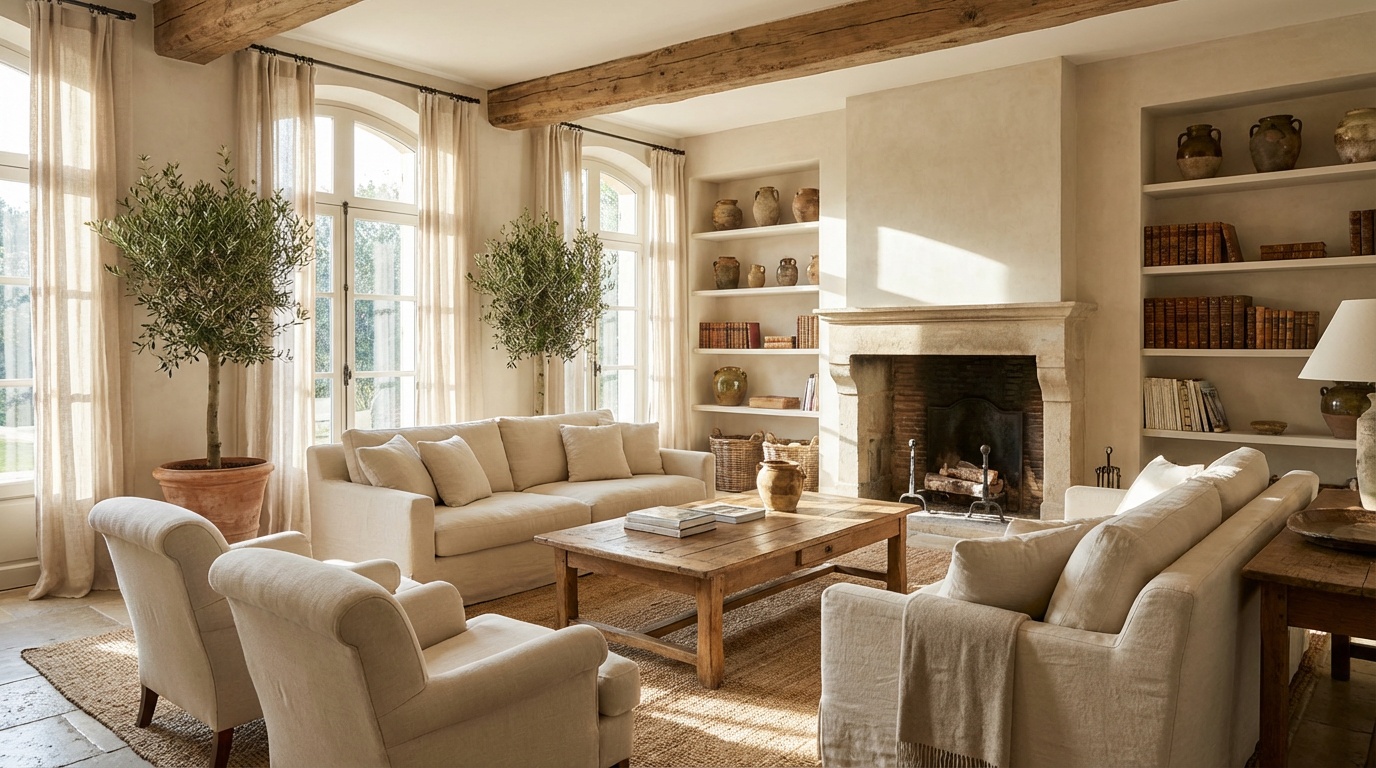
Lighting is crucial in creating the warm, inviting atmosphere that defines French country living rooms. The goal is to achieve a soft, natural glow that feels like perpetual golden hour.
Natural lighting should be maximized and celebrated. French country homes traditionally feature tall windows with simple treatments that allow maximum light penetration. For your living room, opt for linen curtains in white or cream that filter light softly rather than blocking it. Hang curtains high and wide to make windows appear larger and allow curtains to be pulled completely away from the window during the day. Avoid heavy, dark drapes or anything too formal with swags and jabots.
If privacy is a concern, consider wooden shutters painted in soft white or a muted blue-gray. Interior shutters are authentically French and allow you to control light while maintaining the aesthetic. Alternatively, simple café curtains covering just the lower half of windows provide privacy while allowing light from above.
Artificial lighting should be layered to create depth and flexibility:
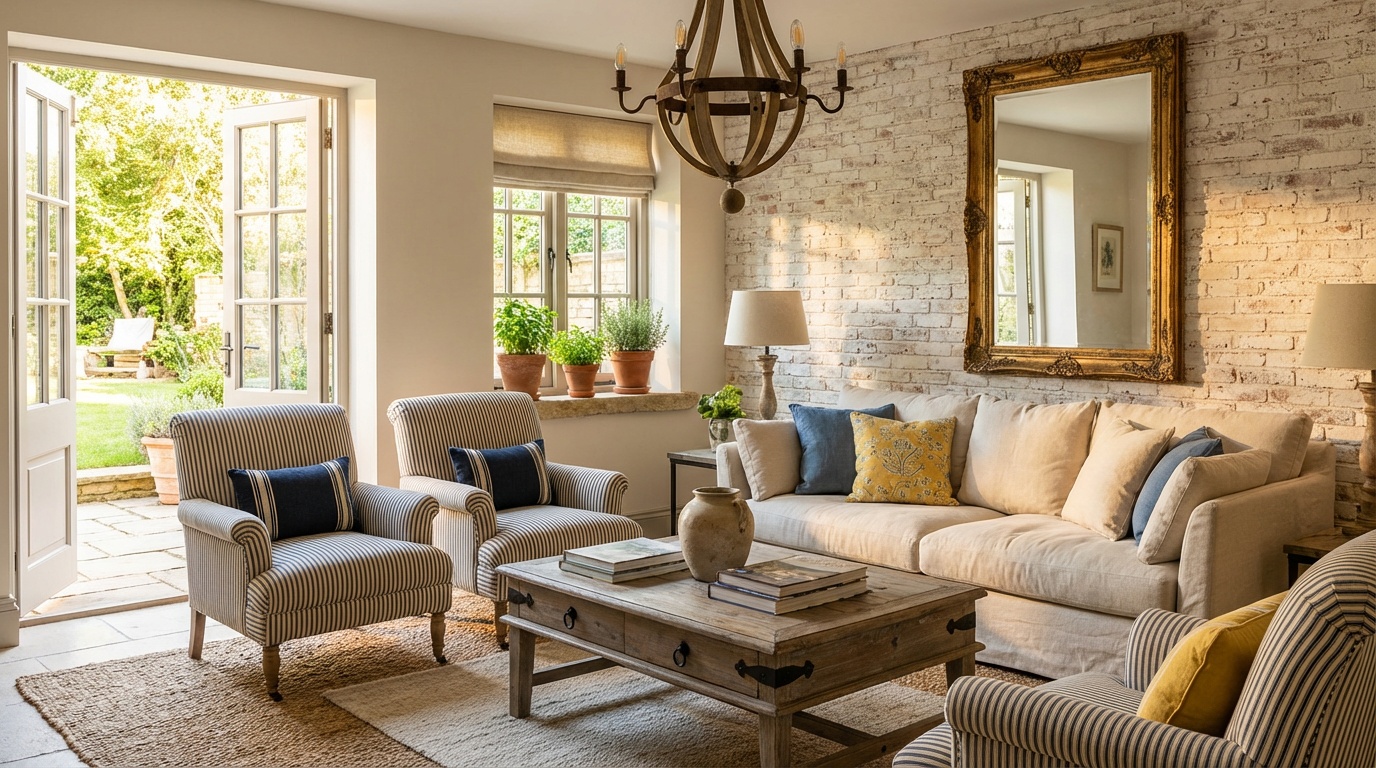
Ambient lighting provides overall illumination. A wrought iron chandelier serves as the room's focal point and primary light source. Look for designs with curved arms, candelabra-style bulbs, and an aged or distressed finish. The chandelier should be substantial but not overly ornate—think rustic elegance rather than ballroom glamour. Alternatively, a wooden chandelier with metal accents or a lantern-style pendant works beautifully in French country spaces.
Task lighting addresses specific activities. Place table lamps on side tables flanking the sofa for reading light. Choose lamps with ceramic, pottery, or turned wood bases in neutral tones, topped with simple linen or burlap shades. A floor lamp with an adjustable arm can provide reading light near a bergère chair without requiring a side table.
Accent lighting creates ambiance and highlights architectural features or decor. Wall sconces in wrought iron or aged brass add romantic, flickering light when fitted with candelabra bulbs. Picture lights above artwork or a mantel lamp on the fireplace add intimate pools of light. Don't underestimate the power of candlelight—French country style embraces the warm glow of candles in iron holders, mercury glass votives, or simple ceramic candlesticks.
For bulb selection, choose warm white LEDs (2700K-3000K) that mimic the glow of incandescent bulbs. Avoid cool white or daylight bulbs, which feel too harsh and clinical. Dimmer switches are essential for adjusting light levels throughout the day and creating the perfect ambiance for entertaining.
The placement of lighting matters as much as the fixtures themselves. Create multiple light sources at varying heights—overhead chandelier, table lamps at mid-level, and perhaps candles or accent lights at lower levels. This layering prevents harsh shadows and creates a welcoming, dimensional space. Position lamps to highlight the room's best features—a beautiful armchair, a collection of pottery, or architectural details like exposed beams or a stone fireplace.
Lighting & Ambiance
Furniture & Decor Shopping Guide
Creating a French country living room doesn't require a trip to France or unlimited funds. Strategic shopping and smart investments can achieve the look at various price points.
Investment pieces worth splurging on:
Quality linen sofa: This is your room's foundation. Invest in a well-constructed sofa with a solid hardwood frame and down-blend cushions. Brands like Restoration Hardware, Arhaus, and Serena & Lily offer excellent French country-appropriate sofas. Expect to spend $2,500-$5,000, but this piece will last decades.
Antique or vintage bergère chairs: Authentic French armchairs add instant credibility and character. Shop estate sales, antique stores, or online marketplaces like 1stDibs or Chairish. A pair of quality bergères runs $800-$2,500, but they're timeless investments.
Statement chandelier: A beautiful wrought iron or wooden chandelier transforms the entire room. Invest in quality here—look at Visual Comfort, Circa Lighting, or Currey & Company. Budget $500-$1,500 for a piece that will be a focal point for years.
Budget-friendly alternatives:
- IKEA hacks: The EKTORP sofa with a custom linen slipcover (from companies like Comfort Works or Bemz) creates a French country look for under $1,000.
- Target's Threshold line and World Market offer affordable French country-inspired furniture and decor.
- HomeGoods and TJ Maxx regularly stock French country accessories, linens, and small furniture pieces at fraction of retail prices.
- Wayfair and Overstock carry budget-friendly chandeliers and furniture with French country styling starting around $200-$500.
Where to shop:
- High-end: Restoration Hardware, Arhaus, Serena & Lily, Pottery Barn, Ballard Designs
- Mid-range: West Elm, Crate & Barrel, Anthropologie Home, Rejuvenation
- Budget: IKEA, Target, World Market, HomeGoods, TJ Maxx, At Home
- Online: Wayfair, Overstock, Joss & Main, One Kings Lane, Chairish (vintage)
- Antique/Vintage: Local antique stores, estate sales, Craigslist, Facebook Marketplace, eBay
Vintage and secondhand finds that work exceptionally well:
- Wooden farm tables and benches
- Vintage French posters and botanical prints
- Antique mirrors with ornate frames
- Ceramic pitchers, crocks, and pottery
- Vintage linen textiles and grain sacks
- Old wooden shutters for wall decor
- Wrought iron architectural salvage pieces
- Vintage books with beautiful spines
The beauty of French country is that aged, imperfect pieces are prized, making secondhand shopping ideal. Don't worry about matching sets—the eclectic, collected-over-time look is authentically French.
DIY projects to achieve the look affordably:
Chalk paint furniture transformation: Give modern or dated furniture a French country makeover with chalk paint in soft white, gray, or blue. Distress edges gently with sandpaper for an aged appearance.
Custom slipcovers: Sew simple linen slipcovers for existing sofas and chairs, or have them made affordably through online services.
Create a gallery wall: Frame vintage botanical prints, French posters, or pages from old books for affordable artwork.
DIY linen curtains: Sew simple rod-pocket curtains from linen fabric—much more affordable than purchasing ready-made.
Repurpose vintage finds: Turn an old door into a coffee table, vintage shutters into wall art, or wooden crates into storage.
Similar to farmhouse living room ideas, French country style rewards creative repurposing and thrifty finds, making it accessible regardless of budget.
Furniture & Decor Shopping Guide
Common Mistakes to Avoid
Even with the best intentions, certain missteps can prevent your living room from achieving authentic French country style. Here are the top mistakes and how to avoid them:
Mistake 1: Going too matchy-matchy
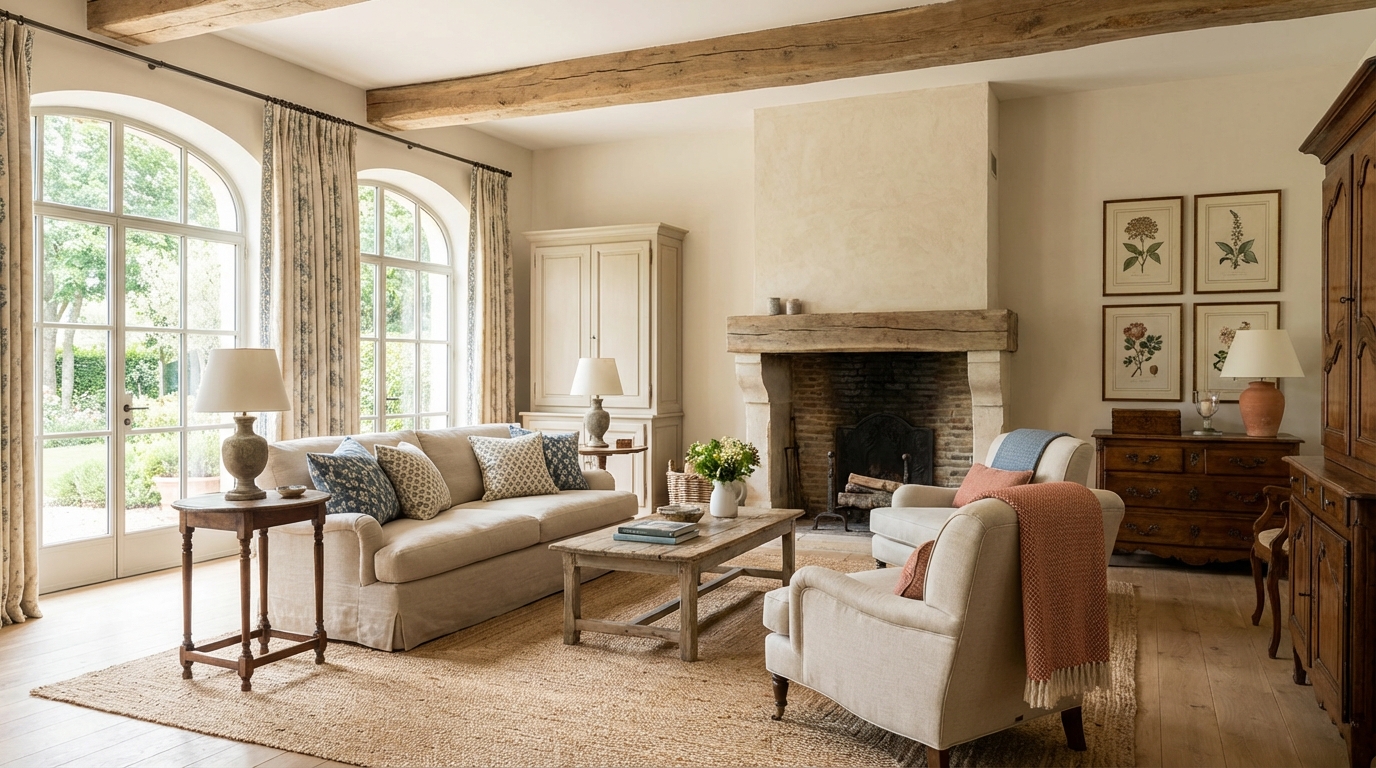
Many people purchase complete furniture sets thinking it will create a cohesive look, but French country is about curated collections, not matching suites. A perfectly matched sofa, loveseat, and chair set in identical fabric screams furniture store, not French countryside.
How to fix it: Mix your upholstery fabrics while staying within the same color family. Pair a solid linen sofa with patterned bergère chairs. Combine different wood tones and furniture periods. The room should look collected over time, with each piece having its own character while contributing to the overall harmony.
Mistake 2: Choosing colors that are too saturated or bright
French country relies on muted, sun-faded colors that feel organic and soothing. Bright primary colors, neon accents, or overly saturated jewel tones clash with the aesthetic's natural, aged quality.
How to fix it: If your colors feel too bright, you've likely chosen the wrong shade. Replace bright yellow with golden honey tones, swap vivid blue for dusty periwinkle, and trade fire-engine red for faded terracotta. Every color should look like it's been gently bleached by the Provençal sun. When in doubt, add white or gray to any color to mute it appropriately.
Mistake 3: Neglecting texture and layering
A French country room that's all smooth surfaces and minimal accessories will feel cold and incomplete. This style thrives on textural richness—the nubby weave of linen, the grain of weathered wood, the rough texture of stone or plaster.
How to fix it: Layer textures deliberately. Combine smooth painted furniture with rough-hewn wooden beams, soft linen upholstery with nubby wool throws, sleek pottery with rustic baskets. Add depth through varied materials—wood, iron, linen, cotton, ceramic, stone, and glass should all coexist. Don't forget vertical texture through wall treatments like exposed brick, stone, or textured plaster.
Mistake 4: Over-accessorizing or creating clutter
While French country isn't minimalist, there's a fine line between charming abundance and cluttered chaos. Too many small accessories, excessive collections, or overcrowded surfaces detract from the style's inherent elegance.
How to fix it: Edit ruthlessly. Group similar items together rather than scattering them—five ceramic pitchers displayed together on a shelf make a statement, while five pitchers scattered throughout the room create visual noise. Leave breathing room on surfaces. Not every shelf needs to be full, and negative space is as important as what you display. Follow the rule of three—arrangements of three objects in varying heights typically feel balanced and intentional.
Mistake 5: Ignoring architectural context
Trying to force French country style into a sleek modern condo with floor-to-ceiling windows and concrete floors can feel disjointed. While the style is adaptable, completely ignoring your home's existing architecture creates tension rather than harmony.
How to fix it: Work with your architecture, not against it. If you have modern bones, incorporate French country through furnishings, textiles, and accessories while acknowledging the contemporary shell. Focus on bringing in natural materials, soft colors, and vintage pieces that create warmth without fighting the architecture. Conversely, if you have traditional architecture, emphasize and enhance those features—expose beams if you have them, highlight original hardwood floors, or draw attention to a beautiful fireplace mantel.
Signs your space is missing the mark: The room feels too formal and untouchable, colors are too bright or too dark, everything matches perfectly, surfaces are cluttered with small items, or the space lacks warmth and feels cold despite French country elements.
Common Mistakes to Avoid
Styling for Different Budgets & Spaces
French country style is remarkably adaptable to various space constraints and budget limitations. Here's how to make it work for your specific situation.
Small space adaptations:
French country can absolutely work in compact living rooms—in fact, the style's emphasis on comfort and livability makes it ideal for cozy spaces.
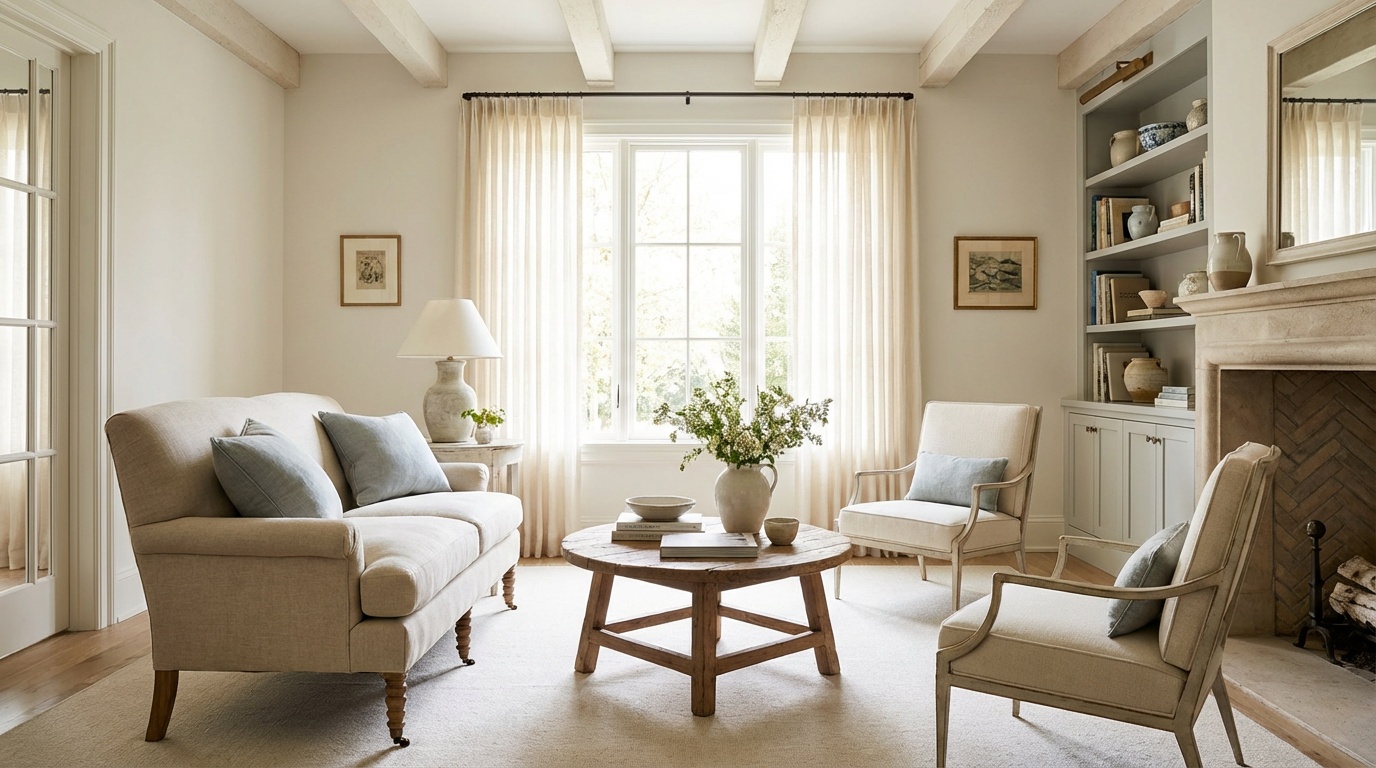
- Choose furniture with exposed legs rather than skirted pieces to create visual airiness and make the room feel larger
- Opt for a loveseat instead of a full sofa, paired with one or two bergère chairs
- Use mirrors strategically to reflect light and create the illusion of more space—an ornate French mirror above the fireplace or opposite a window works beautifully
- Stick to lighter colors from the French country palette—whites, creams, and soft grays keep small spaces feeling open
- Embrace vertical storage with tall armoires or étagères rather than spreading storage horizontally
- Keep patterns smaller in scale to avoid overwhelming the space
- Use multi-functional pieces like an ottoman that provides storage, seating, and a coffee table surface
Rental-friendly approaches:
You can create French country style without making permanent changes:
- Focus on furniture and textiles rather than architectural changes—your sofa, chairs, curtains, and rugs do most of the heavy lifting
- Use removable wallpaper in a subtle French pattern or soft neutral color for an accent wall
- Add a large area rug to define the space and introduce pattern and warmth without altering floors
- Bring in portable lighting through table lamps, floor lamps, and plug-in sconces rather than replacing fixed fixtures
- Create a gallery wall with command strips that won't damage walls
- Use furniture to hide architectural elements you can't change—position a beautiful armoire to block a view of less attractive features
Budget tiers for transformation:
Under $500:
- Linen curtain panels: $100-150
- Vintage bergère chair from Facebook Marketplace: $150-200
- Linen throw pillows and soft throw blanket: $80-100
- Affordable table lamp: $50-75
- Accessories (pottery, books, candlesticks): $75-100
- DIY chalk paint furniture refresh: $25-50
This budget focuses on layering French country elements into your existing space through textiles, one statement furniture piece, lighting, and accessories.
$500-$2,000:
- IKEA sofa with custom linen slipcover: $600-900
- Pair of vintage or reproduction bergère chairs: $400-600
- Wrought iron chandelier: $200-400
- Linen curtains for multiple windows: $200-300
- Area rug: $200-400
- Table lamps and accessories: $200-300
- Artwork and mirrors: $100-200
This mid-range budget allows for significant furniture updates while mixing affordable and investment pieces.
$2,000+:
- Quality linen sofa: $2,500-4,000
- Pair of antique bergère chairs: $1,200-2,500
- Reclaimed wood coffee table: $600-1,200
- Statement chandelier: $500-1,500
- Custom linen curtains: $400-800
- High-quality area rug: $500-1,500
- Antique armoire or bookcase: $800-2,000
- Lighting, artwork, and accessories: $500-1,000
This higher budget allows for investment-quality pieces that will last for decades.
Phasing the transformation over time:
You don't need to complete your French country living room all at once. Here's a strategic approach:
Phase 1 (Months 1-2): Start with paint and textiles. Change wall colors if needed, add linen curtains, and introduce throw pillows and blankets in French country colors and patterns. These changes are affordable and make immediate impact.
Phase 2 (Months 3-4): Invest in your primary seating—either a quality sofa or a pair of chairs. This is your biggest investment, so save and choose carefully.
Phase 3 (Months 5-6): Add lighting—a statement chandelier and table lamps transform the ambiance significantly.
Phase 4 (Months 7-9): Bring in secondary furniture—coffee table, side tables, or storage pieces. Shop vintage and secondhand to find unique pieces at better prices.
Phase 5 (Months 10-12): Complete the look with artwork, mirrors, and accessories. By this point, you'll have a clear sense of what your room needs, making these final purchases more intentional.
This phased approach is similar to how you might approach traditional living room ideas, building the foundation before adding layers of personality and refinement.
Styling for Different Budgets & Spaces
Bringing Your Vision to Life
The hardest part of any design project is visualizing the final result before you commit to purchases. You might love French country style in theory, but how will it actually look in your specific living room with your particular layout, lighting, and existing features?
This is where visualization becomes invaluable. Before spending hundreds or thousands of dollars on furniture, paint, and decor, seeing your space transformed digitally allows you to experiment risk-free. You can try different color palettes, furniture arrangements, and styling approaches to find what works best for your unique space.
RoomStudioAI makes this visualization process incredibly simple. Instead of relying on imagination or expensive design consultations, you can upload a photo of your current living room and instantly see it transformed into a French country haven. The AI-powered tool understands the core principles of French country design—the color palettes, furniture styles, textures, and accessories that define the aesthetic—and applies them to your actual space.
This technology allows you to:
- Test different color schemes to see whether soft gray-blue or warm cream works better with your lighting
- Visualize furniture placement before purchasing to ensure pieces fit proportionally
- Experiment with various levels of rusticity—from refined French elegance to more casual Provençal farmhouse
- See how French country style works with your existing architectural features
- Share visualizations with family members to get buy-in before making changes
- Create a clear shopping roadmap based on what you see in the rendered image
The beauty of using RoomStudioAI is that it's completely free to try. You're not committing to anything—just exploring possibilities. Upload a photo, select French country style, and within moments you'll have a professional-quality rendering showing your living room's potential. You might discover that French country is exactly what you envisioned, or you might realize you prefer a slightly different approach. Either way, you're making informed decisions rather than expensive guesses.
Many homeowners find that seeing the visualization gives them the confidence to commit to the style. It's one thing to admire French country living rooms in magazines or on Pinterest; it's quite another to see your own space transformed. The visualization bridges the gap between inspiration and reality.
Once you've created your ideal French country living room visualization, use it as your guide. Save the image to your phone and reference it while shopping. It becomes your North Star, helping you make decisions about paint colors, furniture purchases, and accessories that align with your vision. You'll spend less time second-guessing and more time creating the beautiful, welcoming French country living room you've been dreaming of.
The journey to a French country living room doesn't have to be overwhelming or risky. With the right inspiration, practical guidance, and modern visualization tools like RoomStudioAI, you can confidently transform your space into a timeless retreat that combines rustic charm with refined elegance. Start by visualizing your possibilities today—your French country living room is closer than you think.