
Ever tried selling a house with nothing but bare walls and empty floors? It’s a tough gig. Buyers often struggle to see the potential in a vacant space—it can feel cold, impersonal, and surprisingly small. This is precisely the problem virtual staging software for real estate was created to solve.
At its core, this technology is a digital toolkit that lets agents and designers add realistic furniture and decor to photos of empty rooms. It’s a way to transform a blank canvas into a beautifully furnished, inviting space that helps potential buyers instantly visualize themselves living there. Think of it as a cost-effective and incredibly fast alternative to traditional home staging.
What Is Virtual Staging and How Does It Work?
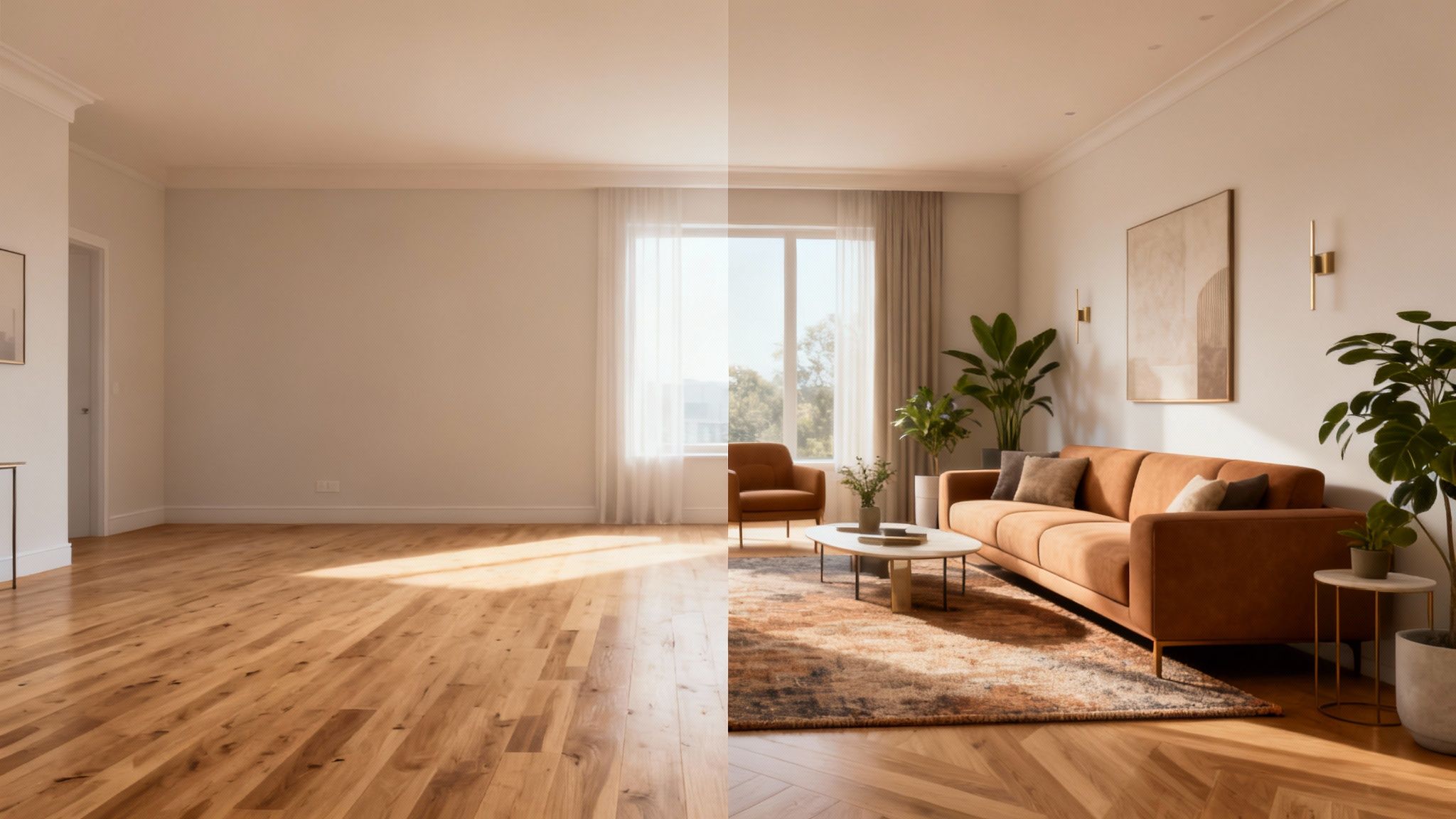
Let’s be honest: traditional home staging is a huge production. You’re hiring designers, renting expensive furniture, coordinating movers, and physically arranging every last cushion and lamp. It works, no doubt, but it can cost thousands of dollars and take weeks to pull off before you can even think about taking photos.
Virtual staging delivers the same visual punch without any of the physical headaches. Instead of hauling a real sofa into a living room, a digital artist or an AI-powered platform places a photorealistic 3D model of one into a high-resolution photo of the room. The software is smart enough to match the lighting, render accurate shadows, and respect the room's perspective, making the final image look completely natural.
This isn't just a fancy photo edit; it's a strategic marketing tool. It turns a sterile listing into a compelling vision of a future home, forging an emotional connection with buyers from their very first click.
A Quick Look: Traditional vs. Virtual
To really see the difference, a side-by-side comparison makes it clear. Traditional staging has its place, but the efficiency and flexibility of virtual staging are hard to ignore in today's market.
| Attribute | Traditional Staging | Virtual Staging |
|---|---|---|
| Cost | $2,000 - $7,000+ per project | $20 - $100 per image |
| Time | 1-3 weeks for setup | 24-48 hours turnaround |
| Flexibility | Limited to one style per setup | Unlimited styles and revisions |
| Logistics | Complex; requires movers, rentals | Simple; just need photos |
| Buyer Impact | High (in-person) | High (online first impression) |
The table really drives home how virtual staging removes the biggest barriers—time and money—while still delivering the visual impact needed to attract buyers online.
Helping Buyers See "Home"
The real magic of staging—whether physical or virtual—is that it bridges the "imagination gap." Most people aren't designers; they can't easily gauge a room's size or picture furniture layouts in an empty box. An unstaged property feels like a project. A staged one feels like a home.
Virtual staging software nails this by:
- Showing Potential: It turns an ambiguous spare room into a cozy home office, a fun playroom, or a welcoming guest suite, instantly giving the space purpose.
- Creating Warmth: Adding furniture, rugs, art, and plants makes a property feel more livable and sparks an immediate emotional response.
- Highlighting Key Features: A smart virtual furniture arrangement can draw the eye to architectural details like big windows, a beautiful fireplace, or high ceilings.
By presenting a polished, move-in-ready look online, you capture far more interest and give buyers a compelling reason to book a viewing. Modern tools like RoomStudioAI take this even further, allowing you to create different design styles for the same room with just a few clicks. In a market where your first impression is almost always digital, that kind of versatility is a game-changer.
The Technology Behind AI-Powered Virtual Staging
So, how does an empty room transform into a beautifully furnished, photo-perfect space in just a few seconds? It feels like magic, but it’s actually some seriously sophisticated AI doing the heavy lifting. For a real estate agent, this technology turns what used to be a major marketing headache into a real competitive edge, all hidden behind a simple, intuitive interface.
It all starts when you upload a good, clear photo of a vacant room. That picture is the canvas. The moment it’s uploaded, the virtual staging software for real estate gets to work, acting like a digital surveyor with an uncanny eye for detail. It doesn't just see a flat image; it meticulously deconstructs the space to understand it from the inside out.
The AI isn't just dropping furniture into a photo. It's performing a detailed architectural analysis in milliseconds, ensuring every digital object interacts with the room's unique lighting and geometry as if it were physically present. This is the key to creating images that are indistinguishable from reality.
From Analysis To Aesthetic Vision
Once the software has the photo, it performs several critical tasks at once. These complex algorithms are what make the final result look so believable, making sure every detail feels grounded in the physical space.
- Spatial Analysis: First, the AI maps out the room's boundaries—the walls, floor, and ceiling. This creates a 3D model of the room’s dimensions and layout.
- Perspective Mapping: It then figures out the camera's angle to ensure any furniture it adds is scaled and positioned correctly. No floating sofas or tiny armchairs.
- Lighting and Shadow Detection: The system analyzes every light source, from a bright window to a recessed light, noting its direction and intensity. It even maps the existing shadows to understand how new objects should cast their own.
With a deep understanding of the room’s environment locked in, the fun part begins. You simply pick a design style you like—maybe ‘Modern Farmhouse,’ ‘Scandinavian,’ or ‘Coastal.’ That single command tells the AI to dive into its massive library of 3D furniture models and decor, pulling together a collection that fits the vibe you're going for.
Rendering A Photorealistic Scene
The final step is where you really see the AI’s power shine. The software's generative engine doesn't just place objects into the photo; it weaves them into the very fabric of the image. Think of it as a digital artist painting with code, adding all the subtle details that make a scene look real. The AI renders each piece of furniture with hyper-realistic textures, from the wood grain on a table to the subtle weave of a rug.
Even more impressive, it calculates precisely how light from the windows would bounce off a glass coffee table or how a floor lamp would cast a warm glow on the wall. Every new shadow is rendered to match the direction and softness of the existing light, creating a scene that feels completely cohesive. This is what turns a process that once took a 3D artist days of painstaking work into a task that’s done in under a minute.
This incredible efficiency gives you amazing flexibility. An agent can create multiple design options for the same room in minutes, showing it off as a home office, a cozy nursery, or a welcoming guest room. You can also explore our guide on using free AI for interior design to see these concepts in action. This combination of speed and realism has completely changed the game for real estate marketing.
Driving Real Business Results with Virtual Staging
Let's be honest, stunning visuals aren't just for show—they're powerful tools that directly impact your bottom line. We've covered the "how" of virtual staging, but its real magic lies in delivering a tangible return on your investment. It's the difference between asking a buyer to imagine the potential of a space and actively showing them. The results speak for themselves.
The most obvious win is the dramatic cost savings. Traditional physical staging is a hefty expense, often running into thousands for furniture rentals, movers, and designer fees. Virtual staging slashes that cost, turning a major budget item into a predictable, low per-image expense. This frees up your marketing dollars for other things that move the needle.
By transforming a major capital expense into a minor operational one, virtual staging allows agents to professionally present every listing, not just high-end properties. This democratizes high-quality marketing for the entire industry.
This simple workflow shows just how quickly AI-powered platforms can turn empty rooms into professionally staged images.
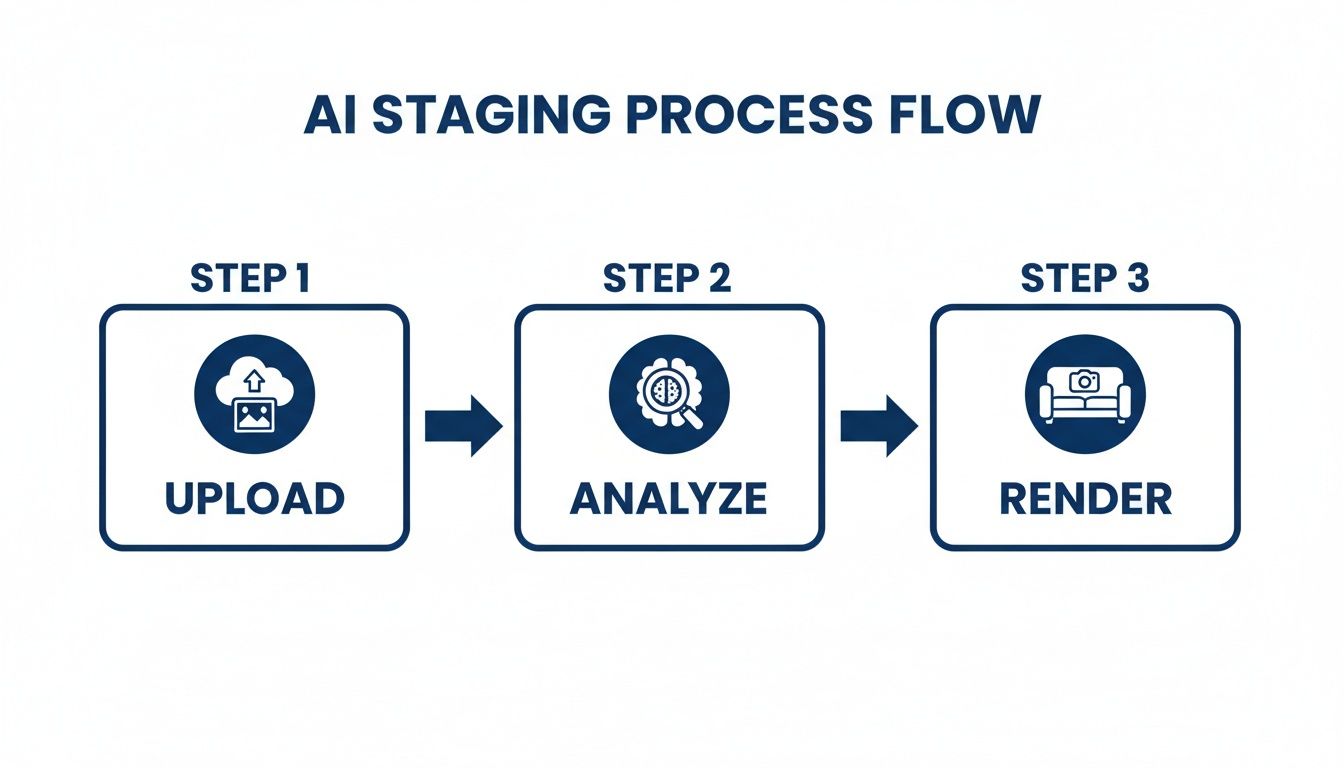
The efficiency of this three-step process—Upload, Analyze, and Render—means you can get listings live faster than ever, capturing buyer interest the moment it peaks.
Accelerating Sales Cycles and Boosting Offers
Beyond saving money, virtual staging has a direct effect on buyer psychology and, ultimately, the sales process. An empty room online gets a quick scroll. A beautifully furnished space, on the other hand, invites a potential buyer to pause, engage, and start building an emotional connection. That connection is what motivates them to book a showing.
Industry data backs this up. The National Association of Realtors' 2025 report found that 81% of buyers find it easier to picture themselves in a staged home. This translates to real results, with nearly 50% of sellers' agents reporting quicker sales. Listings with virtually staged photos often see 73% more online views, which leads to more showings and, crucially, more bids. In fact, 29% of agents saw offer increases of 1-10% or more on staged properties.
This surge in online traffic and emotional appeal creates a competitive buzz around a property, leading to two key outcomes:
- Reduced Days on Market (DOM): Properties that grab more attention right out of the gate simply sell faster.
- Higher Offers: When buyers can truly visualize a property as their "home," they're far more likely to come in with strong, competitive offers.
Expanding Your Marketing Reach and Appeal
One of the most powerful, and often overlooked, benefits of virtual staging is its sheer flexibility. With physical staging, you’re locked into one look. With software, you can create countless variations to target different buyer personas, dramatically widening a single listing's appeal at no extra cost.
This is a game-changer for those versatile spaces like a spare bedroom or a finished basement. An agent can showcase the exact same room with multiple design concepts, speaking directly to what different buyers are looking for.
A Real-World Scenario: Targeting Multiple Buyers
Imagine you're listing a home with a spare room. It could be perfect for a young professional, a new family, or a fitness enthusiast. Instead of leaving it empty and hoping for the best, you can use virtual staging software for real estate to create three distinct versions of your listing photos:
- Version A (The Home Office): Staged with a sleek desk, an ergonomic chair, and great lighting to attract the growing number of remote workers.
- Version B (The Nursery): Furnished with a crib, a changing table, and soft, welcoming decor to connect with expectant parents.
- Version C (The Fitness Room): Outfitted with a yoga mat, free weights, and a mirror to appeal to health-conscious buyers.
You can then deploy these different visual assets across various marketing channels. Run targeted social media ads or email campaigns that speak directly to the lifestyle aspirations of each buyer segment. This tailored approach not only generates more qualified leads but also brilliantly showcases a property's versatility—a key selling point that's nearly impossible to get across with an empty room. To dig deeper into this, see how you can approach interior design with modern tools.
Key Features of Top Virtual Staging Software

When you start looking at virtual staging software for real estate, the sheer number of options can feel overwhelming. But here’s the thing: the best platforms all share a core set of features that set them apart from the pack. Knowing what to look for helps you build a practical checklist and find a tool that doesn’t just make pretty pictures, but actually works for your business.
Think of it like shopping for a professional camera. Sure, any camera can take a picture, but the right one has the specific lenses, sensors, and controls you need to get fantastic results without a headache. It's the same idea here—some features are simply non-negotiable for producing high-quality, professional marketing materials.
These foundational tools are the engine of any serious virtual staging platform, giving you the power to tackle any property, whether it’s a blank-slate new build or a lived-in home that needs a fresh perspective.
Must-Have Foundational Features
Before getting wowed by flashy extras, you need to make sure the core functions are solid. These are the workhorse features you'll use every single day to get listings ready for market, save time, and make every property shine.
- AI-Powered Item and Clutter Removal: This is a lifesaver. It lets you take a photo of a furnished, or even messy, room and have the AI digitally empty it for you. No more hauling furniture or waiting for sellers to declutter. You get a clean slate in minutes.
- Vast and Stylish Virtual Furniture Library: The quality and variety of the digital furniture really matter. A great platform will have thousands of well-designed items in every style imaginable, from Modern Farmhouse to Scandinavian Minimalism. This lets you perfectly match the decor to the home and its ideal buyer.
- High-Resolution (4K) Image Output: Your listing photos are going everywhere—social media, your website, print flyers. Exporting images in 4K resolution is crucial to keep them looking sharp and professional on any screen, from a small phone to a massive monitor.
These three features are the bedrock. They solve the most common staging challenges and give you the power to create a stunning visual presentation for any space.
Game-Changing Advanced Capabilities
With the basics covered, the advanced features are what truly separate a good tool from a great one. These capabilities go beyond just adding a couch to a photo; they offer creative new ways to market a property and help buyers envision its true potential.
These advanced tools transform the software from a simple photo editor into a comprehensive visualization engine. They allow you to sell not just the "as-is" property but also its future potential, a powerful way to overcome buyer objections about outdated finishes or confusing layouts.
One of the most powerful advanced features is virtual renovation. This lets you digitally swap out flooring, repaint walls, or even give kitchen cabinets a modern facelift right in the photo. It’s an absolute game-changer for a property with dated decor, showing buyers what the home could look like with a few updates. You can learn more about crafting a new vision for a living room design using these techniques.
Another incredible innovation is sketch-to-render technology. This feature can take a basic 2D floor plan—or even a rough hand sketch—and turn it into a fully furnished, photorealistic 3D rendering. It’s an amazing asset for marketing new construction or homes undergoing a major remodel, giving buyers a crystal-clear picture of the final product before it even exists.
How to Choose the Right Virtual Staging Solution
Picking the right virtual staging software for real estate isn't just about ticking boxes on a feature list. It's about finding a true partner for your business—a tool that fits seamlessly into how you already work, respects your budget, and helps you achieve your goals. A smart choice now means you'll have a reliable asset that wins you more listings and helps you sell them faster.
The first thing to look at is how the platform charges. Don't just focus on the price tag; think about how it aligns with your actual business needs. Are you staging a handful of luxury properties each month, or are you running a high-volume operation with dozens of listings? The answer will point you toward the right financial model.
Choosing a provider is a commitment to a specific workflow and ecosystem. Look for a solution that not only meets your current needs but is also dedicated to future innovation, ensuring your marketing toolkit remains competitive as the market evolves.
Evaluating Pricing and Business Alignment
In the world of virtual staging, you’ll generally find two main ways to pay. Getting a handle on how they work is key to making a smart investment.
- Pay-Per-Image: This is as simple as it sounds. You pay a flat fee for every photo you stage. It’s a great fit for agents who only need staging occasionally or are just dipping their toes in the water. The only catch? Those costs can sneak up on you if your business starts to take off.
- Unlimited Subscription: A monthly or yearly plan gives you predictable expenses, which is perfect for busy agents, teams, and entire brokerages. This model frees you up to stage every single listing without worrying about the cost-per-photo, really pushing your return on investment.
Beyond the cost structure, consider how the platform supports your day-to-day operations. For a brokerage, a solution with team-based features is a game-changer, letting multiple agents work together under one umbrella. To see how different models can work, feel free to check out our flexible pricing plans.
Assessing Usability and Support
Let’s be honest: the most feature-packed software on the planet is worthless if you can't figure out how to use it. The best platforms are built for real estate pros, not 3D rendering experts. You want a clean, intuitive interface that lets you upload a photo and get a stunning result with just a few clicks. Take advantage of free trials—they're the perfect way to test-drive the user experience before you sign on the dotted line.
Customer support is just as crucial. When you're up against a listing deadline, you don't have time to wait two days for an email response. Look for providers that offer real, responsive support through live chat, email, or even the phone. A great support team shows that a company gets the fast-paced nature of our business and genuinely cares about its clients.
Verifying Commercial Rights and Innovation
Finally, let's talk about two critical details that often get missed in the fine print: usage rights and a forward-thinking mindset. Before you commit, always, always confirm that your plan includes full commercial usage rights. This is non-negotiable. It means you can use your staged images everywhere—on the MLS, social media, print flyers, and your website—without a single legal headache.
The market for real estate virtual staging software is exploding, valued at USD 285 million in 2024 and on track to potentially reach USD 812 million by 2033. That explosive growth is all about innovation. You want to partner with a company like RoomStudioAI that is obviously pouring resources into its AI technology. This ensures your marketing will stay fresh and effective for years to come. You can read more about this market's rapid expansion and what it means for the future.
Got Questions About Virtual Staging? We've Got Answers.
Jumping into any new technology brings up a few questions. That's completely normal. When it comes to something that can have a big impact on your listings, like virtual staging software for real estate, you want to have all the facts straight. Let's tackle some of the most common things agents and marketers ask before they dive in.
My goal here is to give you practical, no-fluff answers so you can feel confident about adding this tool to your marketing playbook. Let’s clear up any confusion.
Is Virtual Staging Legal and Ethical?
Yes, absolutely—as long as you're transparent about it. Virtual staging is perfectly legal and a standard practice in real estate today, but it all comes down to one simple rule: disclose, disclose, disclose. The whole point is to inspire buyers, not to mislead them.
Nearly every Multiple Listing Service (MLS) requires you to label digitally altered photos as "virtually staged" or something similar. This little note tells buyers they're looking at a design concept to showcase the home's potential. You're helping them visualize life in the space, not trying to hide a crack in the wall or change the home's actual features. It's always a good idea to double-check your local real estate board’s specific rules on this.
Think of it this way: the goal of virtual staging is to sell a vision of what a home could be. When you’re upfront and provide both the staged and empty photos, you build trust while still sparking a buyer's imagination.
How Realistic Do the Final Images Actually Look?
Honestly, the results from modern AI software are stunningly realistic. We've come a long, long way from the early days of just cutting and pasting furniture into a photo. Today's best platforms are incredibly smart; they analyze a room's existing lighting, shadows, and perspective to make sure every new piece of furniture or decor looks like it truly belongs there.
High-end tools can render textures, reflections on a coffee table, and the scale of a sofa with pinpoint accuracy. It's this obsession with the details that makes the final images often impossible to tell apart from a professionally shot, physically staged room. Plus, they generate high-resolution files, so your images will look crisp and professional on every marketing channel you use.
Do I Need to Be an Interior Designer to Use This?
Not in the slightest. In fact, the best virtual staging platforms are built for real estate pros, not design gurus. The whole process is usually boiled down to just a few simple clicks:
- Upload Your Photo: Just start with a good, clear picture of the empty room.
- Pick a Style: Browse a library of pre-designed looks like 'Modern Farmhouse' or 'Mid-Century Modern.'
- Let the AI Do the Rest: The software automatically handles the heavy lifting—placing furniture, adjusting lighting, and getting the scale just right.
This makes it possible for anyone on your team to create beautiful, compelling images without any design training whatsoever.
Can I Use It on a Home That's Already Furnished or Cluttered?
You bet. This is actually one of the most powerful uses for this software. The leading platforms now come with AI-powered object removal, which lets you take a photo of a messy or outdated room and digitally "empty" it in a click.
This gives you a clean slate to work with. From there, you can re-stage the space with fresh, modern furniture that has broad appeal. It's an ideal fix for homes where the seller's personal decor isn't quite right for marketing photos or for properties that simply need a digital decluttering before going live.
Ready to see how you can transform your own listings? RoomStudioAI lets you create incredible, photorealistic staged images in just a few seconds. Try RoomStudioAI for free today and experience the difference yourself.
Ready to redesign your space?
Try our AI interior design tool and see your room transformed in seconds.
Try Free Design

