So, you're thinking about a career in home staging? It's a fantastic field where a good eye for design meets savvy business sense. The path to becoming a successful stager is all about a few key things: getting the right design skills under your belt, creating a portfolio that truly wows, setting up your business correctly, and then getting the word out to real estate agents and homeowners.
Building Your Foundation in Home Staging
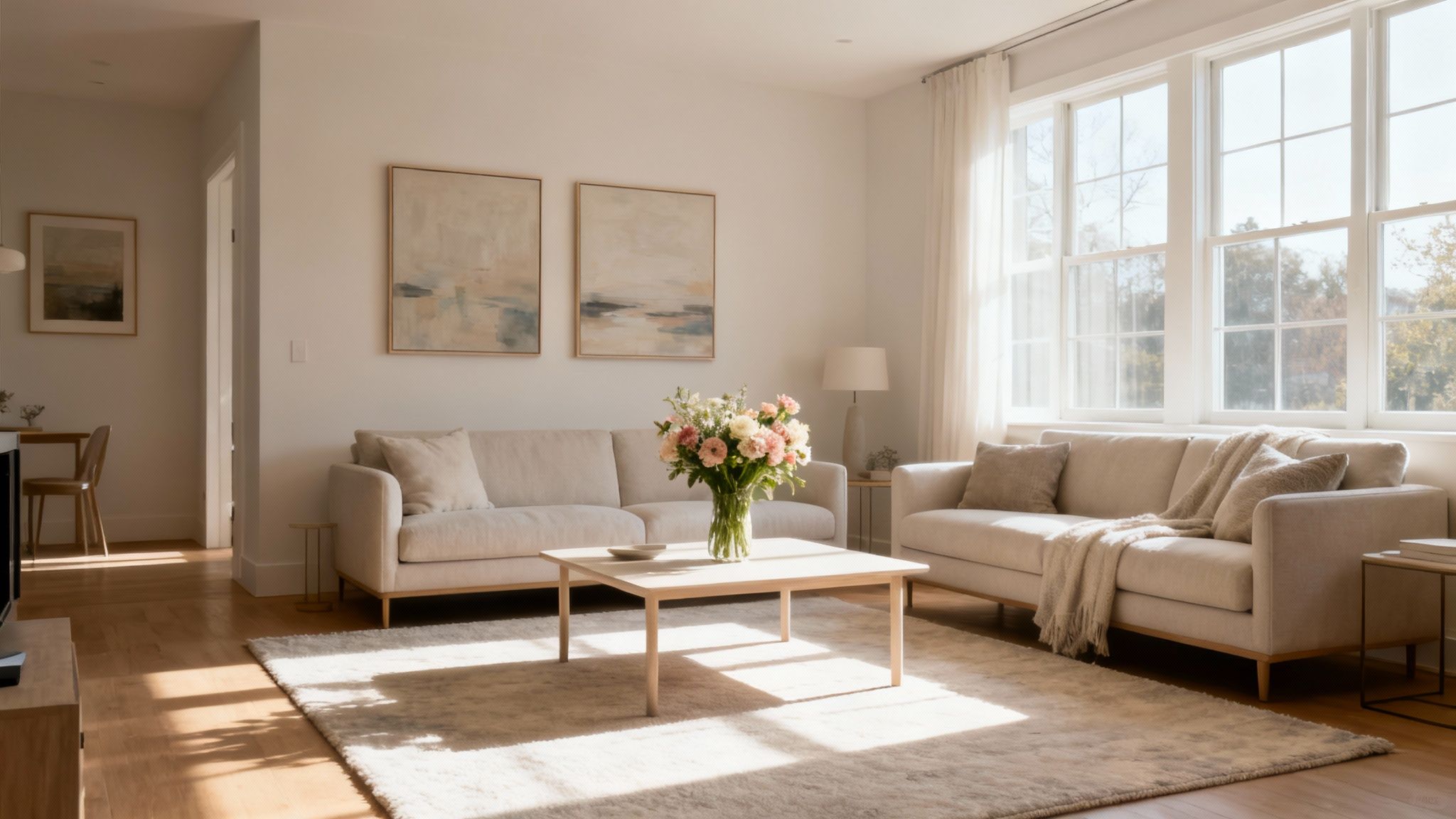
Jumping into a home staging career is so much more than just rearranging a few couches. At its heart, it’s about forging an emotional connection with a space, one that helps a property fly off the market faster and for a better price.
This isn't just about making things look pretty. You're blending artistic talent with a sharp understanding of what sells in the current real estate climate. A great stager doesn't just decorate; they strategically craft an environment that appeals to the widest possible audience of buyers. This guide is your complete roadmap, walking you through everything from the initial training and portfolio building to landing those first crucial clients.
To get a quick overview of what this career path entails, take a look at the table below.
Home Staging Career At-a-Glance
| Aspect | Details |
|---|---|
| Primary Goal | To help homes sell faster and for a higher price by improving their appeal to potential buyers. |
| Key Skills | Interior design principles, color theory, spatial planning, real estate market knowledge, and client relations. |
| Average Salary | Varies by location and experience, but experienced stagers can earn $50,000 to $100,000+ annually. |
| Initial Investment | Can range from low (for consultations) to high (for a full inventory of furniture and decor). |
| Primary Clients | Real estate agents, homeowners, and property developers. |
| Core Value | Increasing a property's market value and reducing its time on the market. |
This snapshot shows that a career in home staging is a legitimate business venture with real financial impact, not just a creative hobby.
Understanding the Stager's Impact
The value a home stager brings isn't just a feeling—it’s backed by hard numbers. You’re stepping into a market where properly staged homes can sell 30–50% faster than their unstaged counterparts.
Better yet, data from the National Association of REALTORS® 2025 Profile of Home Staging shows that a majority of agents see staging increase a home's value by anywhere from 1% to 10%. On a $400,000 home, that's an extra $4,000 to $40,000 in the seller's pocket. That’s a powerful return on investment you can deliver for your clients. Want to dig deeper? Check out the U.S. home staging forecast.
This financial upside is the core of your sales pitch. You're not just offering a design service; you're offering a faster sale and a bigger check at closing.
The Key Pillars of a Staging Career
A sustainable career in this field is built on a few essential pillars. Nail these, and you'll have a solid foundation for your business.
- Design Expertise: You absolutely need a firm grasp of color theory, spatial planning, lighting, and what’s currently trending. Your job is to create an easy flow, make rooms feel bigger, and appeal to today’s buyers.
- Real Estate Market Knowledge: You have to know your local market inside and out. Understand the buyer demographics, common architectural styles, and the features people are looking for. Staging a chic downtown loft requires a completely different approach than a sprawling suburban family home.
- Business Acumen: This is where the entrepreneur in you comes out. It means handling the legal setup (like an LLC), getting the right insurance, drafting solid contracts, and pricing your services to be profitable. You're a business owner first.
- A Killer Portfolio and Marketing: A visually stunning portfolio isn't optional—it's your most powerful sales tool. From there, you'll need a smart marketing plan to connect with real estate agents, who will quickly become your best source of repeat business and referrals.
The best stagers I know all think like buyers, not like the current homeowners. Your mission is to depersonalize a space and turn it into a beautiful blank canvas where buyers can instantly picture their own future.
As you grow, you’ll also find that technology can give you a serious edge. For example, learning how AI can be used for interior design mockups allows you to create and share visual concepts with clients faster than ever. It's the perfect blend of creative passion and smart, strategic execution.
Building Your Skills and Getting Certified
You don't need a four-year interior design degree to become a fantastic home stager, but a "good eye" alone won't get you very far. The real secret to success—and charging what you’re worth—lies in professional training and certification. It’s what separates the hobbyists from the pros and gives clients the confidence to hire you.
This isn’t just about learning where to put a throw pillow. Formal training teaches you the psychology of selling a space. You’ll learn to step outside of your own personal style and create a look that appeals to a broad range of potential buyers. This means digging into color theory to set a mood, mastering spatial planning to make rooms feel bigger, and using light to create a warm, welcoming vibe.
A well-staged home is a silent sales pitch. Your work helps buyers form an emotional connection and see themselves living there.
Choosing the Right Training Program
As you start exploring, you'll come across several reputable certification programs, with organizations like the Real Estate Staging Association (RESA) and Home Staging Resource (HSR) being two of the most well-known. These courses are specifically designed to give you the practical knowledge you need to hit the ground running.
While every program is a bit different, a solid curriculum will always cover the fundamentals:
- Buyer Psychology: Getting inside the heads of potential buyers to understand what truly motivates their decisions.
- Color Theory in Practice: Using color palettes to make a home feel spacious, bright, and camera-ready.
- Space Planning: Arranging furniture to create a natural flow, define different zones, and show off a room’s best assets.
- The Business Side: Learning how to price your services, draft contracts, and build lasting relationships with real estate agents.
Think of these programs as a smart investment in your business. The data consistently shows that professional staging works. A 2025 survey from the National Association of REALTORS® found that nearly 20% of agents saw offers increase by 1% to 5% on staged homes, while another 10% saw jumps between 6% and 10%. You can read more about the impact of staging on home sales to see the numbers for yourself.
Gaining Hands-On Experience Before You Land a Client
Your certificate is important, but nothing beats real-world practice. You can start building your practical skills right now, long before you have a paying client. Start by turning a critical eye on your own home.
Rearrange your living room furniture to improve the flow. Clear everything off your kitchen counters and see how much bigger the space instantly feels. Offer to help a friend pick out a new paint color or reorganize their cluttered home office. Take "before" and "after" photos of everything you do—even the small projects. This is the beginning of your portfolio.
The most important skill you can develop is the ability to see a home not as it is, but as it could be. You're selling potential, and that requires looking past clutter, dated decor, and awkward layouts to find the hidden beauty in every space.
This is where the theory you learn truly clicks. You’ll quickly discover that a paint swatch looks completely different on a full wall, or that the perfect sofa you saw online completely overwhelms a small room. These early lessons are invaluable.
A great way to experiment without moving a single piece of furniture is to play around with a free AI interior design generator. It lets you test out different layouts, styles, and color schemes digitally, helping you train your eye and visualize a room's potential in minutes.
Building a Portfolio and Your Staging Toolkit
Your portfolio is your single most powerful sales tool. Period. It’s the visual handshake that convinces real estate agents and homeowners you can transform their property. But how do you build one when you're just starting out? It's the classic chicken-and-egg problem, but the solution is to create your own opportunities.
Start right where you are. Your own home is the perfect first project. Treat it like a real client, taking high-quality "before" and "after" photos of every step. Declutter a room, rearrange the furniture to improve the flow, and bring in a few new decor pieces. This initial project is proof you understand the core principles of staging.
Next, tap into your network. Offer to stage a key room—like the living room or primary bedroom—for friends or family who are selling their home or just want a refresh. In exchange, ask for professional photos and a glowing testimonial. It’s a fantastic, low-risk way to get hands-on experience and add more diverse projects to your portfolio.
Using Technology for a Competitive Edge
Building a portfolio used to be a slow, expensive grind. It meant needing physical access to properties and a massive investment in furniture and decor. Thankfully, technology has completely changed the game.
Today, you can use AI tools like RoomStudioAI to build a stunning portfolio at a fraction of the cost. You can take a photo of any empty or cluttered room, pick a design style like minimalist or rustic, and the software generates a photorealistic rendering with shoppable furniture from major retailers. This is a game-changer. Virtual staging can be up to 90% cheaper than physical staging—we're talking $100 versus $2,000+ per room. This modern approach really clicks with real estate agents who need incredible listing photos fast.
This digital-first strategy lets you showcase your versatility with a wide range of styles, from modern farmhouse to coastal chic, without buying a single piece of furniture. You can build a robust, professional-looking portfolio before you even land your first paying client.
Physical vs Virtual Staging Comparison
Understanding when to use physical staging versus virtual staging is key to offering flexible and effective solutions for your clients. Each has its own set of advantages depending on the property, budget, and timeline.
| Feature | Physical Staging | Virtual Staging (with RoomStudioAI) |
|---|---|---|
| Cost | High (rental, moving, labor) | Low (per-image fee) |
| Turnaround Time | Days to weeks | Hours |
| Flexibility | Limited to available inventory | Unlimited styles and furniture options |
| Best For | High-end vacant properties, open houses | Occupied homes, budget listings, pre-construction |
| Impact | Allows buyers to physically experience the space | Excellent for online listings and marketing |
While physical staging offers an irreplaceable in-person experience, virtual staging provides incredible speed, cost-effectiveness, and design flexibility, making it an essential tool for the modern stager.
Assembling Your Essential Staging Toolkit
A great portfolio gets you in the door, but the right tools ensure you deliver flawless results. Your toolkit will be a mix of physical gear for on-site work and digital software to run your business like a pro.
Think of your toolkit in two parts:
- The On-Site Kit: The must-have items you'll carry to every consultation and staging day.
- The Business Kit: The software and digital tools that keep your operations running smoothly.
Let's look at the startup costs. This chart breaks down where your initial investment will likely go.
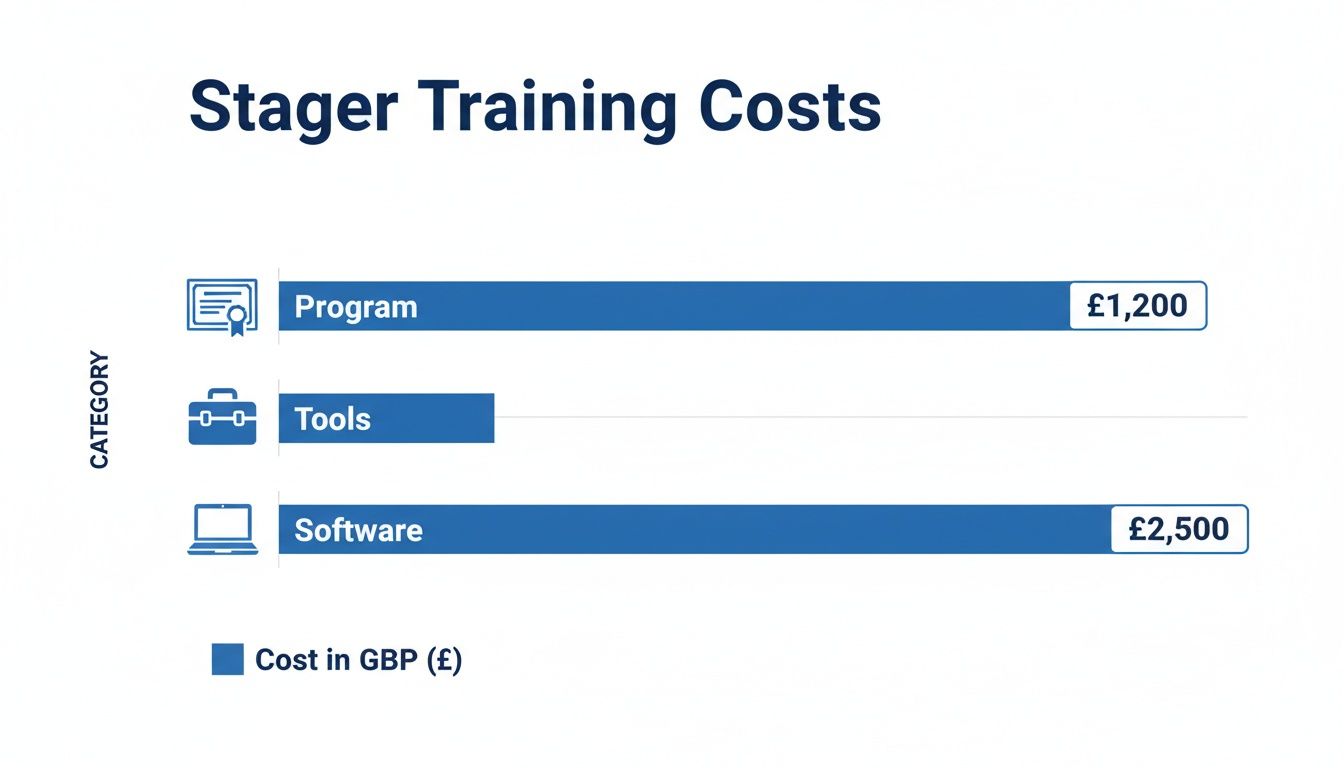
As you can see, while training is a significant cost, investing in the right software and tools from day one is just as crucial for building a sustainable business.
Must-Have Physical and Digital Tools
For your physical kit, start with the essentials. Remember, you're not just decorating—you're a space planner and a problem-solver.
- Measuring Tools: A good laser measure is a lifesaver, but always have a traditional tape measure as a backup.
- Photo Equipment: Your smartphone is a great start, but a simple wide-angle lens attachment will help you capture entire rooms effectively for your "before" shots.
- Basic Hand Tools: A small kit with a hammer, a multi-bit screwdriver, and a level is invaluable for hanging art or making quick adjustments.
- Furniture Sliders: These will save your back and protect your clients' floors. Don't leave home without them.
On the digital side, it's all about efficiency.
Your business will live or die by its systems. The more you can automate and organize on the back end, the more time you can spend on the creative work that actually makes you money.
Start with inventory management software to keep track of your furniture and decor—it becomes non-negotiable as you grow. A tool like RoomStudioAI is also perfect for creating mockups and exploring beautiful living room ideas, which helps clients visualize the end result before you lift a finger. Finally, get a simple accounting program from the start to manage invoices and track expenses. Your future self will thank you.
Getting Your Business Off the Ground and Pricing Your Services
Making the leap from a creative passion to a real, profitable home staging business means you have to start thinking like a CEO. This is where your design eye meets your business brain. It's all about building a solid foundation—making smart moves on legal structures, getting the right insurance, and, of course, figuring out how to price your work so you actually get paid what you're worth.
Honestly, treating your staging practice like a serious business from day one is non-negotiable. It protects you, makes sure you're profitable, and helps you build a reputation that gets real estate agents and homeowners coming back for more.
Choosing Your Business Structure
Before you can put a price on your services, you need a business to price them for. Your first big decision is your legal structure. While you could start as a sole proprietor, a lot of experienced stagers go with a Limited Liability Company (LLC).
Think of an LLC as a happy medium. It creates a protective wall between your personal assets and your business debts, so if something goes wrong on a job, your personal savings aren't on the line. The best part? It offers this protection without the crushing paperwork and complex tax rules of a full-blown corporation.
Next up, you absolutely need the right insurance. It’s not just a nice-to-have; it's a must.
- General Liability Insurance: This is your safety net for any accidents. Say you're moving a sofa and accidentally scratch a client's brand-new hardwood floors—this is the policy that covers the damage.
- Professional Liability Insurance (also called Errors & Omissions): This one covers mistakes related to your professional advice. For example, if a client bizarrely claims your design choices were the reason their home didn't sell, this insurance has your back.
Taking these steps isn't just about checking boxes. It shows clients you're a serious professional they can trust.
How to Actually Price Your Staging Work
Figuring out what to charge is probably the biggest headache for new stagers. There's no magic number, because your rates will shift based on your local market, your experience, and what each project demands. But, most successful stagers build their pricing around a few core models.
A great place to start is with an initial consultation fee. This is a flat rate you charge for a one-to-two-hour walkthrough where you give the homeowner a detailed action plan. This fee can be anywhere from $200 to $600, and it works as a paid discovery session. You're getting compensated for your time and expertise, even if the client decides not to hire you for the full job.
One piece of advice I always give new stagers: Never, ever work for free. It instantly devalues your skills and sets a terrible precedent. Even if you're building your portfolio, frame it as a professional project with a contract and a steep discount—not a freebie.
For the actual staging, you've got a couple of popular options. You can offer room-by-room packages, charging a set fee for high-impact areas like the living room, primary bedroom, and kitchen. This gives clients clear, easy-to-understand pricing. The other common model is a full-home project quote, which you customize based on the property’s size and how much furniture you’ll need to bring in. This usually involves an upfront staging fee plus a monthly rental fee for all the inventory.
Real-World Pricing Examples
To make this a bit more concrete, here are some sample pricing structures. Remember, these are just ballpark figures—you’ll need to adjust them for your own market.
| Service Tier | Description | Price Range |
|---|---|---|
| Consultation Only | A detailed walkthrough and a written staging report. | $250 - $500 (Flat Fee) |
| Vacant Home Staging | Staging key rooms in a totally empty property. | $1,800 - $5,000+ (Initial) + monthly rental |
| Occupied Staging | Using the homeowner's furniture and supplementing with rentals. | $800 - $2,500 (One-time fee) |
When you're trying to land on your final numbers, do some recon. See what other stagers in your city are charging. You want to be competitive, but you don't want to undercut the entire market (or yourself). Also, think about how technology can create new service tiers. For example, check out RoomStudioAI's pricing plans to see how you could offer virtual staging as a more affordable alternative or add-on service.
Crafting Proposals and Contracts That Protect You
Your proposal and contract are the most important documents you'll create. They spell everything out, protecting you and your client from misunderstandings down the road. A killer proposal should always include:
- Scope of Work: Be crystal clear about which rooms you're staging and what's included (furniture rental, delivery, de-staging, etc.).
- Detailed Pricing: Break down every single cost. No surprise fees.
- Project Timeline: Give them a clear schedule for staging day and when you'll de-stage after the home sells.
- A Visual Element: Include a mood board or mockups so they can get excited about the final look.
Once they say yes, you need a signed, legally binding contract. It should echo all the details from the proposal and add clauses for things like property damage, payment deadlines, and cancellation policies. This isn't just bureaucratic paperwork—it's the bedrock of a professional, trusting relationship with your client.
Marketing Your Business and Finding Your First Clients

You've built the foundation—your business is registered, and you know your numbers. Now comes the exciting part: actually finding people who will pay you to work your magic. Let's be clear, marketing yourself as a home stager isn't about shouting from the rooftops. It's about smart, targeted relationship-building.
Your entire marketing effort boils down to one goal: positioning yourself as the secret weapon for real estate agents and homeowners who want to sell a property faster and for more money. This requires a mix of old-school networking and a sharp online presence. You have to be strategic, stay consistent, and always be ready to prove your worth.
Forge Powerful Alliances with Real Estate Agents
Real estate agents are the absolute lifeblood of any successful staging business. They’re not just a source of leads; they are your repeat customers, your biggest advocates, and the key to a sustainable career. Think of them less as clients and more as strategic partners.
Start by zeroing in on the top-producing agents in your area. Who is closing the most deals? Look up their current listings. Get a feel for their brand, the price points they work with, and the neighborhoods they dominate. This homework allows you to tailor your pitch so you sound like someone who understands their specific world.
When you do reach out, lead with value, not with an ask.
- Offer a "Lunch and Learn": Propose a quick, casual presentation for their brokerage team on the real ROI of professional staging. Bring coffee and donuts—it goes a long way.
- Create Co-Branded Materials: Design a simple, elegant one-page PDF that an agent can easily share with their clients. Put your best work on it, and leave a spot for their logo. You've just made their job easier.
- Share Market Intel: Keep an eye on local design trends. If you notice that homes with a certain aesthetic are selling in days, share that insight with your agent network.
Your job is to make them look good. When you help them get listings sold over the asking price, you stop being a vendor and become an essential part of their success story.
A simple, direct approach for that first email works best. Try something like this: "Hi [Agent Name], I'm a local home stager and I've been following your listings in [Neighborhood]. I put together a few virtual staging mockups for your property on [Street Name] to show how we could boost its online appeal. Do you have 10 minutes for a quick chat next week?"
Build Your Digital Storefront
In a business as visual as home staging, your website and social media are your 24/7 showroom. This is where potential clients will go to judge your work before they even think about picking up the phone. It needs to be polished, professional, and all about the portfolio.
Your website is the anchor. Make your "before and after" galleries the star of the show, with big, beautiful, high-quality images. But don't stop there. Get active on Instagram and Pinterest, where your ideal clients and agent partners are already looking for inspiration.
These platforms aren't just for posting pretty pictures. They're for demonstrating your expertise. The virtual staging mockups you can whip up with RoomStudioAI are marketing gold here. Create an Instagram carousel post: slide one is the empty room, and the next three slides show it staged in different styles (e.g., modern farmhouse, mid-century, minimalist). Ask your followers, "Which style would sell this home the fastest?" You'll get engagement while showcasing both your design sense and your tech-savvy approach.
If you're interested in adding another income stream, you can even look into our guide on how to become an affiliate and partner with tools you already use.
Collect and Showcase Powerful Social Proof
Nothing sells your services better than a glowing review from a happy client. Getting testimonials isn't an afterthought; it should be a core part of your project wrap-up process from day one. That rave review from an agent or homeowner is pure gold, giving new prospects the confidence they need to hire you.
The perfect time to ask is right after a property sells, especially if it was a quick sale or went for over the asking price. That’s when your client is feeling the most thrilled with the outcome. Send a short, personal email with a direct link to your Google Business Profile, Houzz, or whichever platform you prefer.
Don't be afraid to gently guide them. You could say something like, "If you have a moment to share your experience, we'd be so grateful. Future clients find it really helpful to hear about specifics, like how quickly the home sold or if the staging impacted the final offer." This prompts them to provide the kind of specific, results-driven details that will impress your next client.
Got Questions About Becoming a Home Stager? Let's Talk.
Jumping into home staging is an exciting move, but it’s smart to go in with your eyes open. You've probably got some very practical questions about what it really takes to get a business off the ground. Let's tackle the big ones so you can move forward with confidence.
What’s the Real Startup Cost for a Home Staging Business?
The money question—everyone wants to know! The honest answer is, it truly depends on the business model you choose. You don't have to mortgage your future to start.
For a lean, consultation-focused business, you can realistically get started for somewhere between $3,000 and $7,000. This budget covers the essentials and lets you start earning before you even think about buying a warehouse full of furniture.
So, where does that money go? Here's a typical breakdown from my experience:
- Training & Certification: This is your foundation. Expect to invest $1,000 to $2,500 for a quality program. It’s non-negotiable for building credibility.
- Business Setup: Getting legitimate costs money. Budget $500 to $1,500 for things like registering your LLC, getting a business license, and basic liability insurance.
- Key Software & Tools: This includes your website, a portfolio platform, and design software. Investing in a tool for virtual staging mockups is one of the smartest, most cost-effective moves you can make early on.
- Initial Marketing Push: Think professional headshots, business cards, and a small budget for online ads. Setting aside $500 to $1,000 here is a good start.
This approach gets you in the game without the crushing overhead of a full inventory.
Do I Really Need to Own All My Own Furniture?
This is probably the biggest myth in the industry. The answer is a resounding no. In fact, I’d argue that buying a warehouse of furniture from day one is a huge financial mistake for most new stagers.
The smart way to operate, especially when you're starting out, is with a rental or hybrid model. You partner with specialty furniture rental companies for the big pieces—sofas, beds, dining tables—and build that cost directly into your client's proposal. This keeps you nimble and protects your cash flow.
Owning every single piece of furniture is a fast track to debt. A smarter strategy is to build a "staging kit" of high-impact, versatile accessories—think neutral art, elegant bedding, stylish throw pillows, and quality faux plants. These core items can be used across multiple projects, while you rent the big-ticket items.
This hybrid model gives you the best of both worlds. You have your signature accessories that define your style, but you avoid the massive costs and logistical nightmares of storing and moving heavy furniture. It’s all about minimizing risk while you build your client base.
How Fast Can I Realistically Get My First Paying Client?
Landing that first client is a huge milestone. With a focused game plan, you can make it happen faster than you think. I've seen new stagers land their first paying gig within two to four months.
But there's a catch: that timeline starts the moment you commit. It assumes you're actively working on your business, not just thinking about it. Procrastination is your worst enemy here.
To hit that goal, you need to be doing these three things simultaneously:
- Finish Your Certification: Don't drag it out. Get it done so you have the credentials and the confidence to pitch yourself.
- Build a Portfolio—Now: Don't wait for a client. Stage your own home, a friend’s place, or use virtual staging software to create compelling "before and after" examples. You need visuals to sell your service.
- Start Networking Immediately: Don't wait until you're "ready." Start introducing yourself to local real estate agents while you're still in training. Let them know you're entering the market and share your developing portfolio.
Consistent, daily action is what separates the successful new stagers from the ones who never quite launch.
Can I Start a Staging Business Part-Time?
Absolutely. Home staging is one of the most flexible careers out there, which makes it perfect for a side hustle. The workflow is actually well-suited for someone still working another job.
Most of your initial client consultations and the actual hands-on staging days can be scheduled for evenings or weekends. This lets you build your business, your portfolio, and your income stream without giving up the security of your full-time paycheck. Once your client list is booming, you can make a smooth, confident transition whenever you’re ready.
Ready to build that stunning portfolio without buying a single piece of furniture? With RoomStudioAI, you can transform empty room photos into beautiful, realistic staging mockups in seconds. It’s the perfect tool to showcase your skills and land those first crucial clients. Explore RoomStudioAI today and start designing your future.
Ready to redesign your space?
Try our AI interior design tool and see your room transformed in seconds.
Try Free Design

